News

16.5.2022
Central Museum of Textiles in Łódź is pleased to invite you to the opening of the „Second Skin” exhibition.
19th of May 2023 at 6:00 p.m.
Central Museum of Textiles in Łódź, building A, 3rd floor
282 Piotrkowska Street, Łódź
Curator: Marta Lisok
The artists taking part in the exhibition were invited to play with the selected objects from the collections of the Central Museum of Textiles in Łódź. It was a point of departure for reading the stories woven in the textiles and telling them through other media: installations, video art, and audio works.
From this perspective, the museum storehouses emerge as the remnants of a molting process – a collection of soft forms recalling shapes of bodies to which they increasingly conformed through wear.
Using the textiles as tools for working with body memory served as an impulse to imagine stories of their past users. The exhibition narrative centers on concepts tied to the use of textiles: their covering, wrapping, and revealing. These gestures were treated as the germs of stories coming from the lives of individuals and generations.
The Second Skin exhibition is the result of an international project titled Interweaving Structures: Fabric as Material, Method, and Message, organized by the Central Museum of Textiles in Łódź, the Doctoral School of the Jan Matejko Academy of Fine Arts in Krakow, and the University of Bergen — Faculty of Fine Art, Music and Design, supported by a grant from Iceland, Liechtenstein and Norway through EEA Grants and co-financed by the Polish funds. We are working together for a green, competitive and inclusive Europe.
--
Exhibition curator: Marta Lisok
Featuring: Grzegorz Demczuk, Monika Drożyńska, Paweł Błęcki, Pamela Bożek, Olga Konik, Filip Rybkowski, Piotr Madej, Natalia Mecnarowska-Legutko, Marta Krześlak, Agata Jarosławiec, Ala Savashevich, Jagoda Dobecka, Kuba Święcicki, Laika Marie Frandsen Andersen, Clea Filippa Ingwersen, Wiktoria Gazda, Live Skaar Skogesal, Thea Weis, Katinka Halland
Curatorial cooperation: Tim Parry-Williams
Project expert team: Jakub Gawkowski, Marta Kowalewska, Marta, Lisok, Tim Parry-Williams, Anne Szefer-Karlsen, Magdalena Ziółkowska
Production: Teofila Włodarczyk
Exhibition design: Bartek Buczek
Graphic design: Daria Malicka
Technicians: Paweł Barski, Damian Krężel, Paweł Łuczyński, Dariusz Pikus, Sebastian Weiss
Conservators: Agata Pawelec, Justyna Czerwiowska, Ewa Suchy, Marlena Wiśniewska
Translation: Soren Gauger

9.11.2022
Picturesque Podlachia is another place visited by participants in the Interweaving Structures: Fabric as Material, Method and Message project. PhD students from the Jan Matejko Academy of Fine Arts in Krakow and students from the University in Bergen walked the Folk Crafts Trail through the workshops of artisans, learning the history of Podlachia’s weaving—including the famous double-warp textile, of course—and the material culture in the Białystok borderlands. The young artists were also inspired by a visit to the Janów textile center, and if you would like to see the abundance of colors and patterns they encountered along the way during the Podlachia residency, just have a look at our film.
video by HaWa
8.11.2022
Strolls down Piotrkowska Street, through the Old Cemetery or Księży Młyn, visits to Łódź’s cultural institutions and artisan workshops—this was, of course, not all participants in the Interweaving Structures: Fabric as Material, Method and Message project experienced during their first residency. During their stay in Łódź they had a chance to look at our city as a place with a remarkable textile tradition, where history and modernity entwine.
Come have a look at the film of the Łódź residency — meet the participants of our international project, featuring PhD students from the Jan Matejko Academy of Fine Arts in Krakow and students from the University in Bergen.
video by HaWa
9.9.2022
The last residency (Bergen, August 4–10) with the participants in the Interweaving Structures: Fabric as Material, Method and Message project more sharply brought into focus the ties between historical designs, old weaving techniques, and contemporary production methods. The history of akle (traditional comforters with a characteristic color-scheme and striped patterns) was presented by artist Marta Kløve Juuhl, while Kari Dyrdal, long-time textiles professor at the Art Department of the University of Bergen, spoke of the history of contemporary textile art in Norway, present not only in gallery institutions, but also in public buildings.
The visit to Utne, situated on the Hardanger fjords, home to the Folkemuseum, was another chance to see traditional embroidery, folk textiles, and traditions particular to this region. Then visiting Arne, not far from Bergen, the participants could compare the beginnings of the cotton industry in northern Norway with their experiences in Łódź and Białystok. One example of the rebirth of the industrialist tradition in this town is the Oleana family company, who have been producing women’s fashions in the spirit of sustainability since the 1990s.
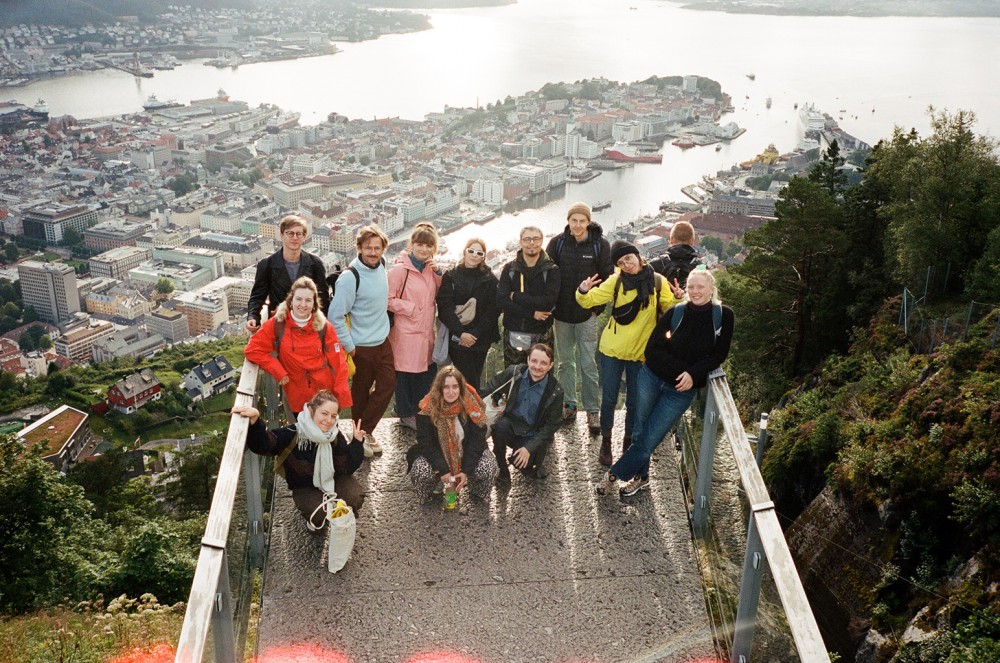
On the ferry to Hardanger Folkemuseum, photo: Ala Savashevich
7.9.2022
The participants in the Interweaving Structures: Fabric as Material, Method and Message project have taken part in another residency, the third to date. During their three-day trip to Oslo and Lillehammer (August 1–3) the invited guests—scholars in visual arts, specialists in historical textiles and material culture—addressed the subject of building a national identity, a “national” culture for Norway, and the role and significance of folk art within it.
At two permanent exhibitions—Impulses at the Maihaugen Muzeum in Lillehammer and Timescope at the Norsk Folkemuseum in Oslo—the project participants had a look at historical textiles, applied art, and national costumes, tracing their stylistic development and regional specificity. The guided tour around the town hall with Professor Jon Pettersen, a specialist in old textile reconstruction, was a chance to admire the textiles, the wall paintings, and the artisanry. Other guests during the residency were contemporary artists—Franz Petter Schmidt and Inger Johanne Rasmussen—whose practice draws from traditional materials, designs, and techniques.
Another important stop was the visit to the monographic exhibition of Synnove Anker Aurdal at the Astrup Fearnely Museum in Oslo, allowing us to trace the stylistic development of this true innovator of postwar textile art, who began working in the late 1940s, combining formal experimentation with the language of contemporary poetry.
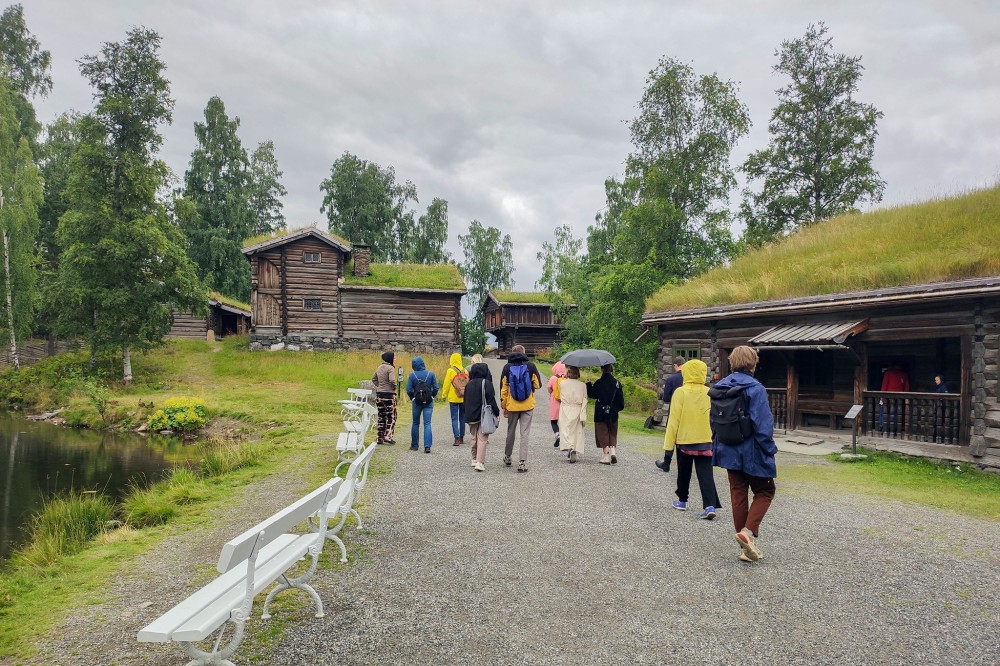
A stroll through an exhibition of historical homes, Maihaugen Museum, Lillehammer. Photo: Magdalena Ziółkowska
23.08.2022
The trip from Łódź to the picturesque Podlachia area kicked off the latest residency (June 19–25) for the participants in the Interweaving Structures: Fabric as Material, Method, and Message project, whose main protagonist was the double-warp fabric—its history, tradition, and technical originality.
PhD students from the Akademia Sztuk Pięknych im. Jana Matejki w Krakowie and students of the University in Bergen walked the “Folk Crafts Trail” through the artisan studios, getting acquainted with the history of Podlachia weaving and material culture at the Białystok province borderlands. They visited Supraśl, Tykocin, Bohoniki, several scenic Podlachia villages, and the Podlaskie Folklore Museum in Wasilków.
The visit to the Janowski weaving center was undoubtedly a source of inspiration for the participants—this is where the double-warp textile traditions are especially alive, and the work prepared by the weavers not only ends up in exhibitions and competitions, they also decorate homes around the world.
The “Ławki” swamp, the famous “moose freeway”, the peat bogs and the sand dunes—a trip through the Biebrza National Park and contact with its unique ecosystem let us gear down and take a rest from the immersion in history and tradition.
The finale of Białystok and strolls through the city’s textile history bookended the two residencies. The Białystok Industrial Region is important as a nineteenth-century center for cotton production, and is stamped, like the Łódź region, by the late twentieth-century fall of the textile industry and the challenges of shifts in society.
For a full report have a look at our website:
Residency concept and moderation: Magdalena Ziółkowska.
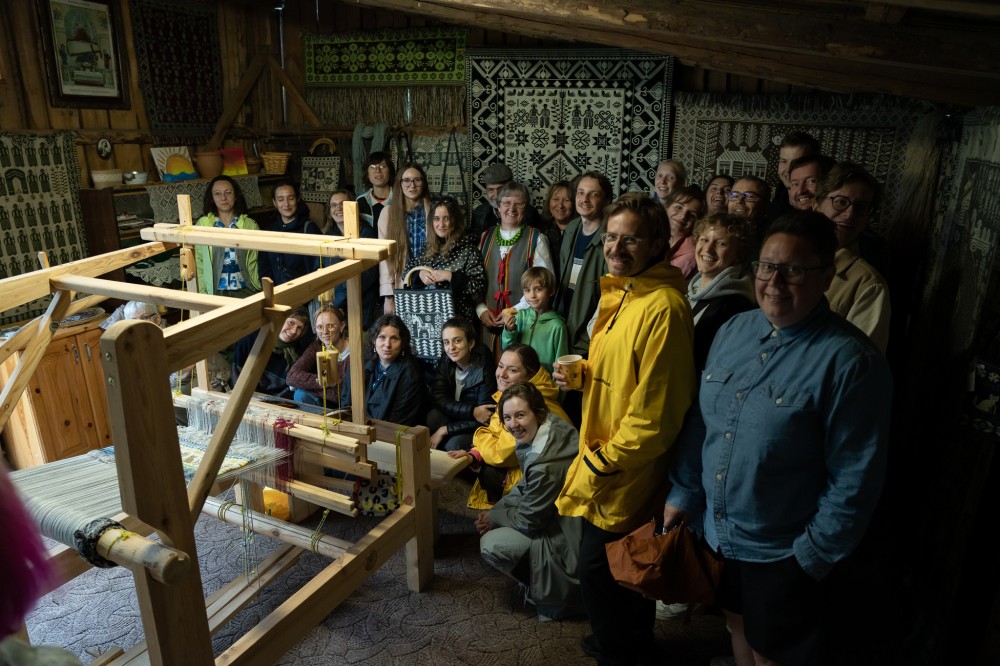
On the Folk Crafts Trail: project participants in weaving workshop of Bernarda Rość in Szaciłówka, photo: HaWa.
12.08.2022
The Interweaving Structures: Fabric as Material, Method and Message project has the wind in its sails! After four online seminars, the time has come for all the participants to meet!
During the first of four residencies that took part in Łódź on June 13–18, doctoral students from the Akademia Sztuk Pięknych im. Jana Matejki w Krakowie and students of the University in Bergen Universitetet i Bergen had a chance not only to uncover the heritage of our city, but also make some new acquaintances and valuable contacts.
The residency program looked at Łódź as a city with an exceptional textile tradition, both in terms of its history (meetings with specialists on the city’s industrial legacy) and the present, showing the textile industry from a research and development perspective.
Walks down Piotrkowska Street and through the Old Cemetery and the Księży Mill alternated with visits to Łódź’s cultural institutions: the Central Museum of Textiles in Łódź, the Book Art Museum, the Museum of the City of Łódź, and the artisan studios with textiles.
For a full report have a look at our website:
Residency concept and moderation: Marcin Gawryszczak.
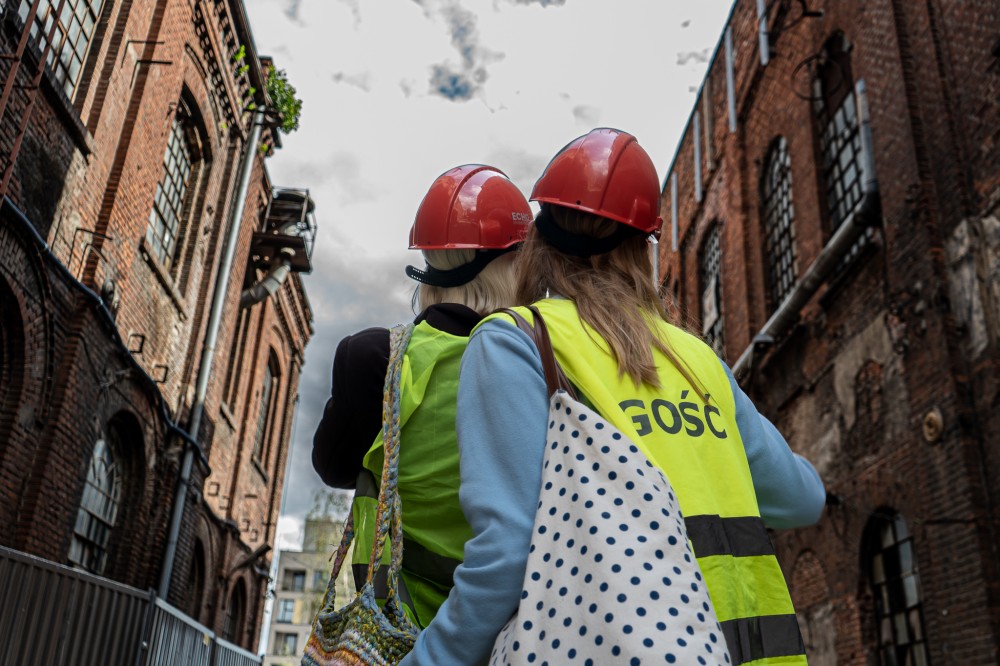
A tour of the former Scheiblers' finishing plant (Tymienieckiego street), photo: HaWa.
28.04.2022
From April 25–27 the first in a series of partner meetings between project curators was held in Bergen, attended by Anne Szefer Karlsen, Tim Parry-Williams, Marta Kowalewska, and Magdalena Ziółkowska, who described the visit as follows:
At the Faculty of Fine Arts, Music, and Design of the University in Bergen, we stopped by the Textiles Workshop and met the team behind the creation and coordination of the project activities, including the residency planned for August 2022 and the international exhibition featuring Polish and Norwegian academy students and graduates.
At the Picnic group exhibition organized at Kunsthall Bergen (curator: Randi Grov Berger) we had a look at graduates’ diploma projects, and for our research for the international exhibition we visited Toril Johannessen and Kioshi Yamamoto in their studios. Toril Johannessen is presently working on completing the Gruppebilde Bergen textile, being made on commission for the Bergen City Hall and featuring portraits of the city’s inhabitants generated through an algorithm based on actual photographs. Kioshi Yamamoto, in turn, showed us some kimonos and Chinese painted silk, large-format jacquards, and designs presently underway for several exhibitions.
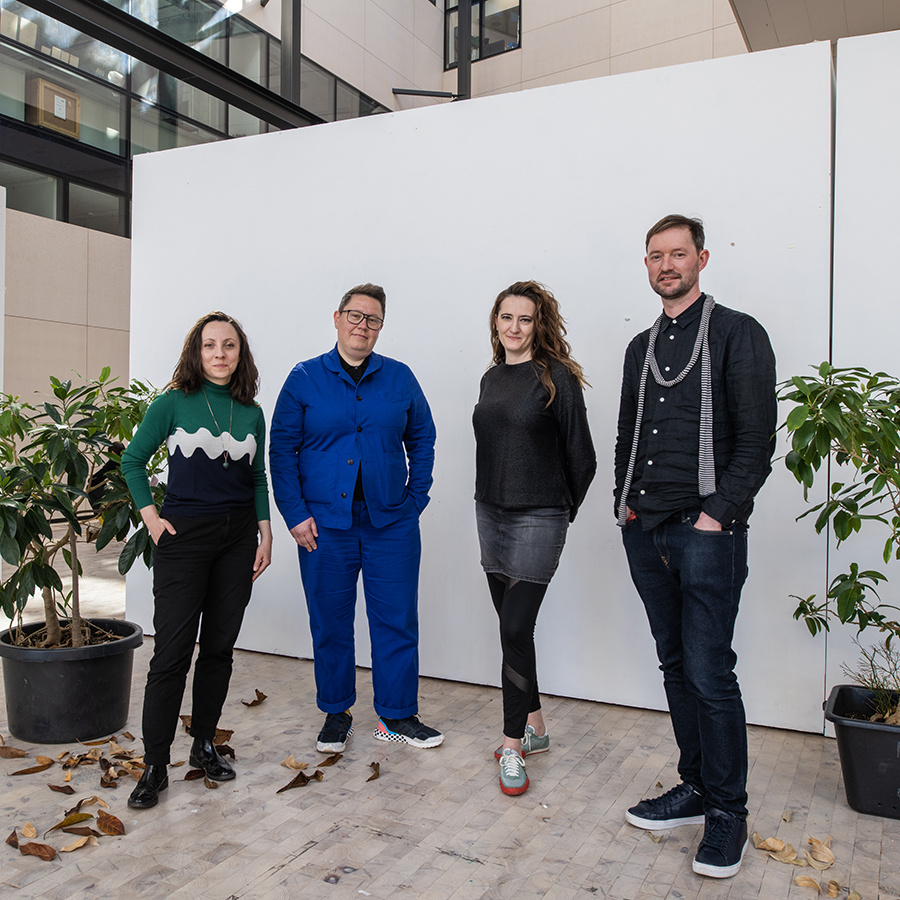
Curators of the project, from left: Magdalena Ziółkowska, Anne Szefer Karlsen, Marta Kowalewska and Tim Parry-Williams, photo: Bjarte Bjørkum.
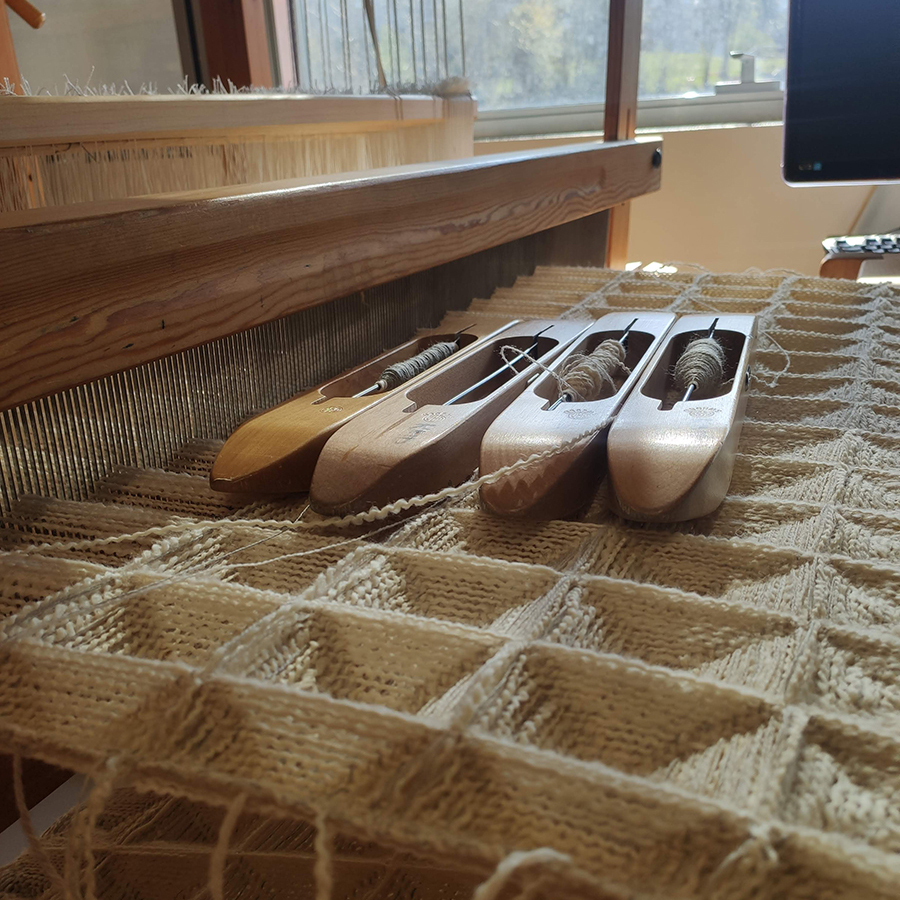
Shuttles and loom in one of the University of Bergen textile workshops, photo: M. Ziółkowska.
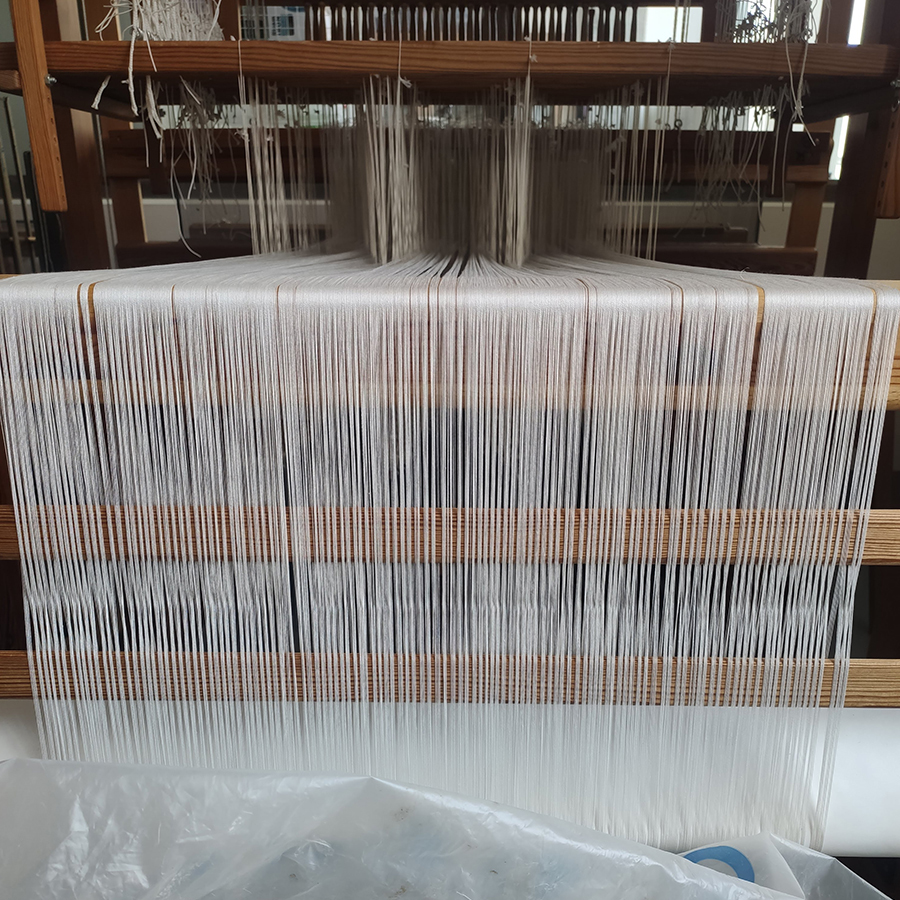
Jacquard loom in one of the University of Bergen textile workshops, photo: M. Ziółkowska.
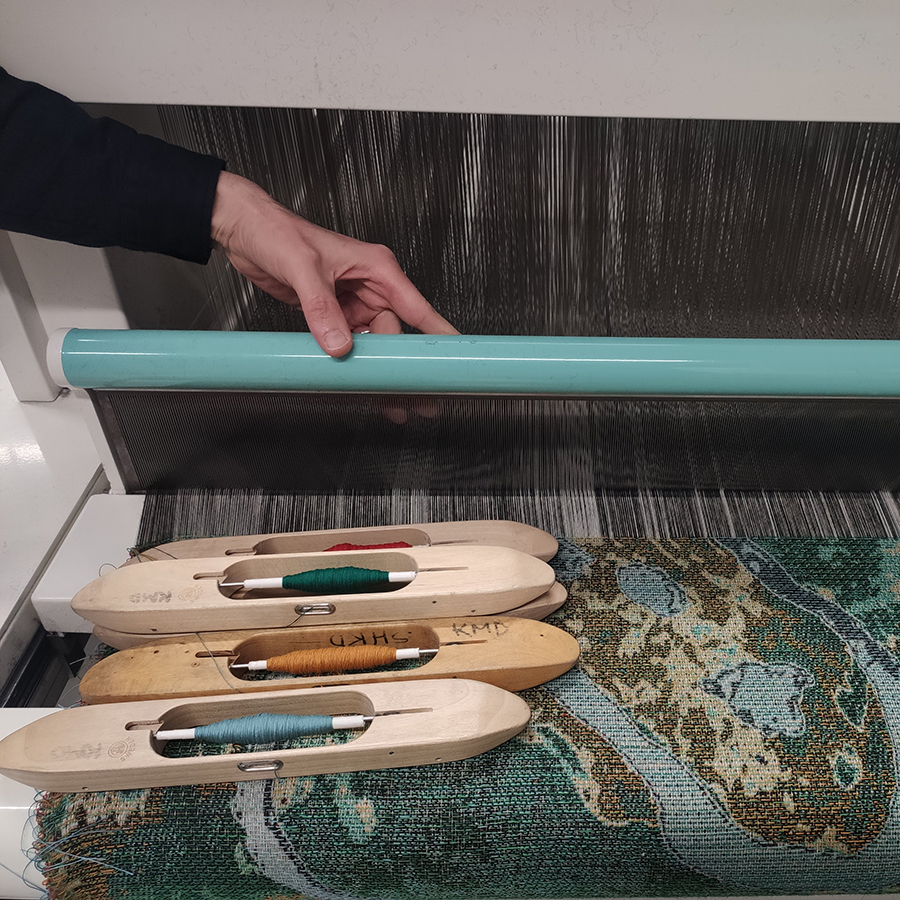
Jacquard loom and shuttles in one of the University of Bergen textile workshops, photo: M. Ziółkowska.
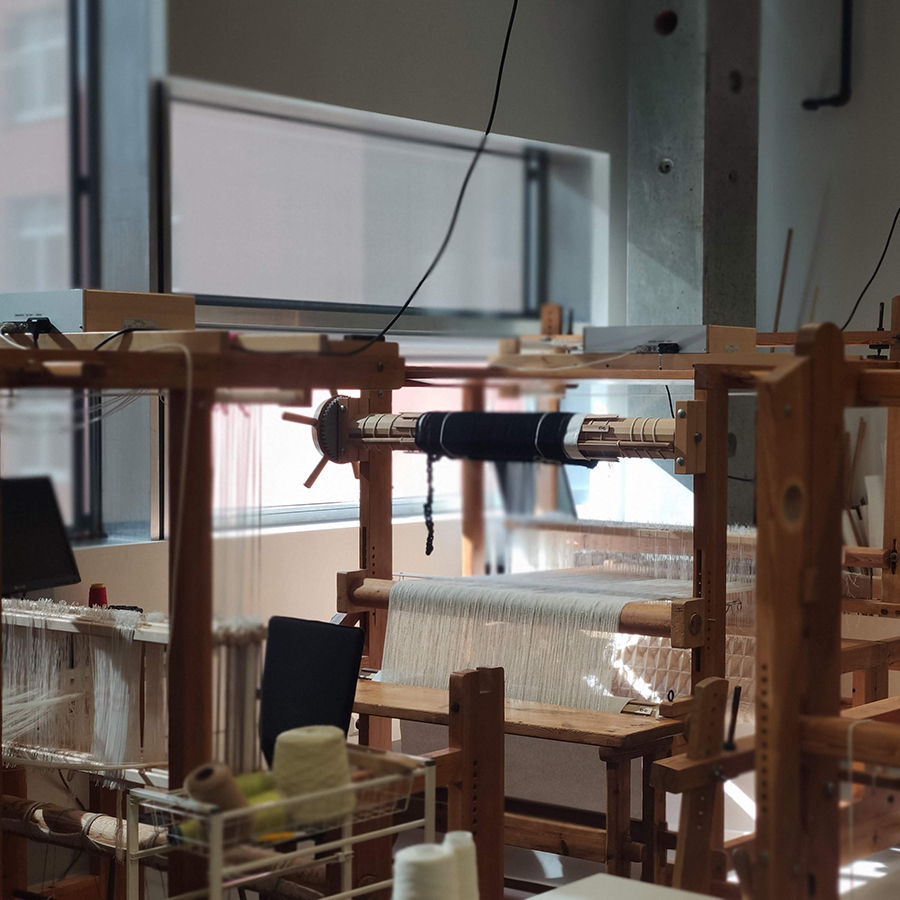
Looms in one of the University of Bergen textile workshops, photo: M. Ziółkowska.
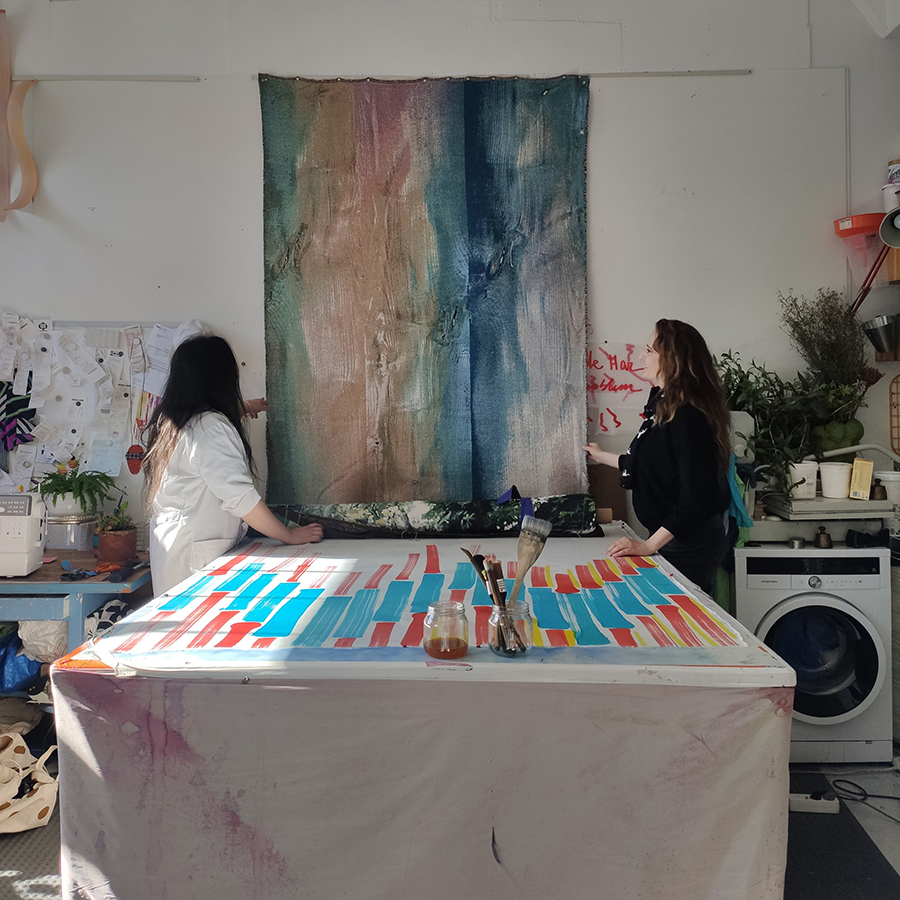
Marta Kowalewska and Kiyoshi Yamamoto in his workshop, photo: M. Ziółkowska.
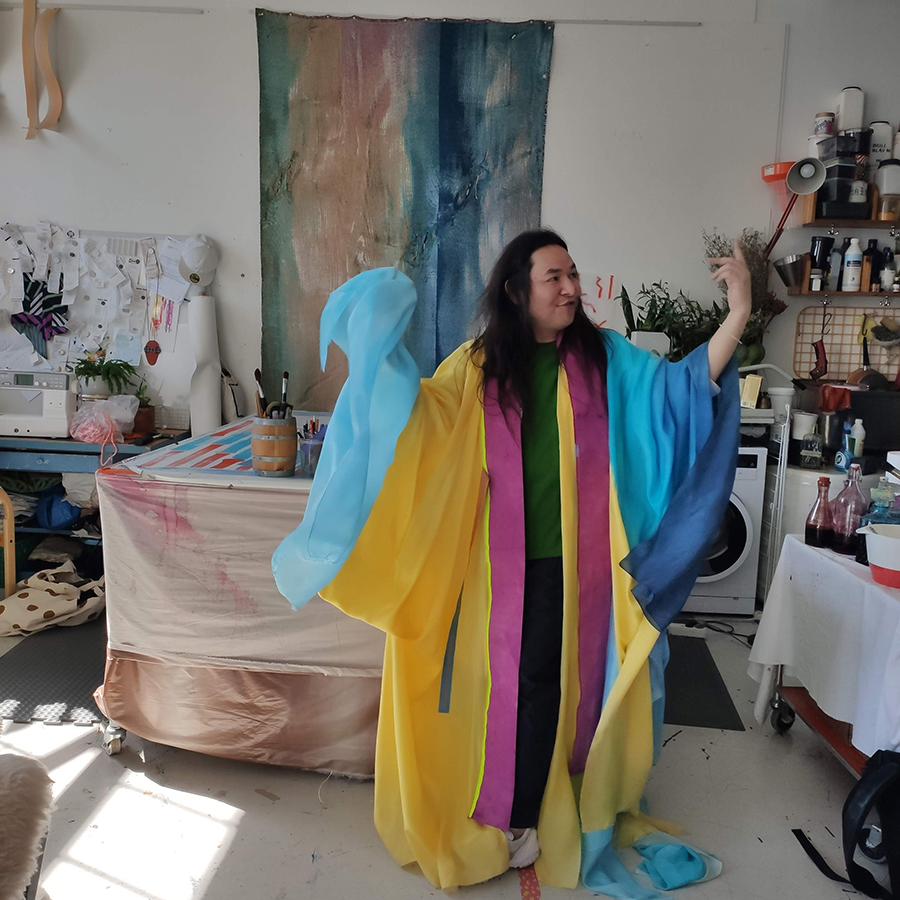
Artist Kiyoshi Yamamoto in his workshop (http://www.kiyoshiyamamoto.com/), photo: M. Ziółkowska.